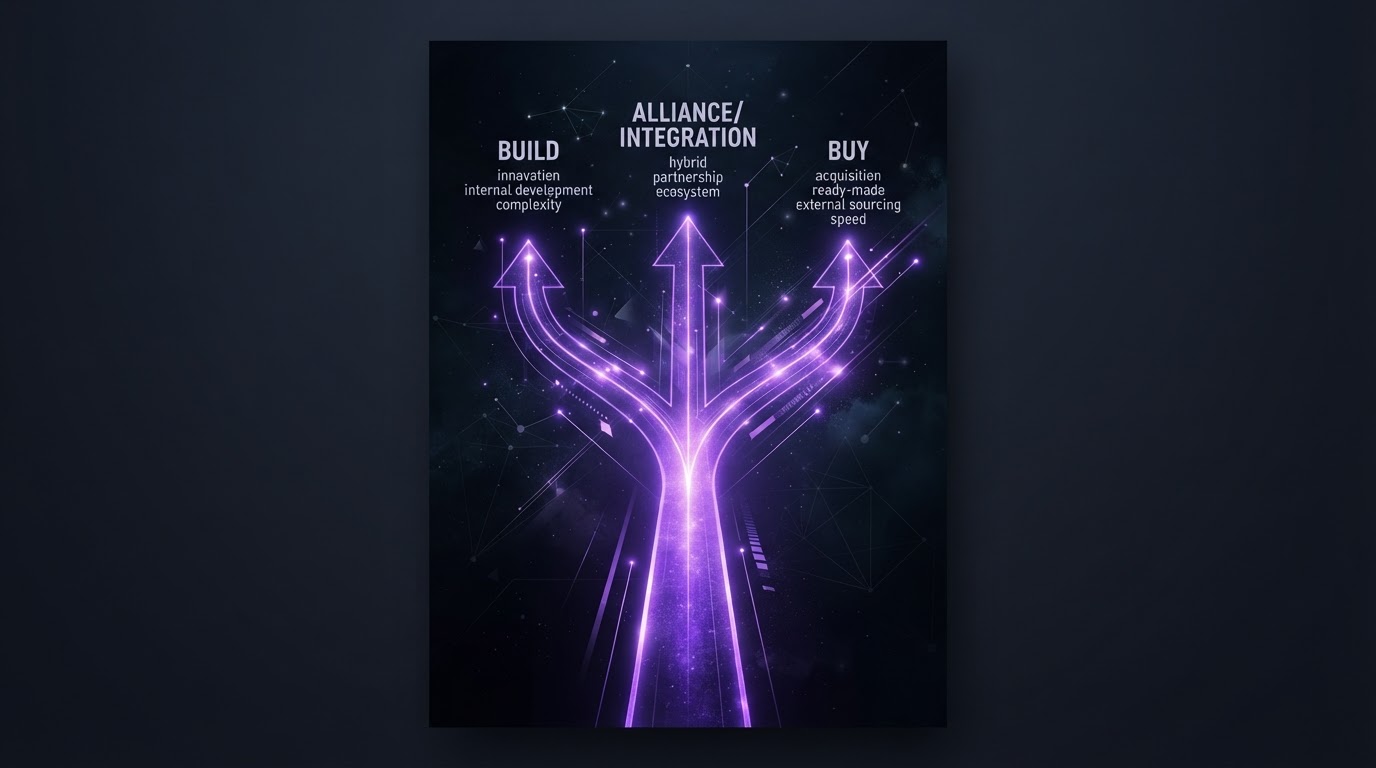
The difference isn't in the ad server. It's in who and how the business is built. All three paths theoretically lead to the same place, but the choice of path determines whether the business comes to exist or stays as a pilot that never scales.
- In-house: 24+ months to first dollar, you have to build the team and there's no playbook.
- Buy software: months of configuration plus learning curve, with no team or playbook included.
- Build with partner: weeks to first dollar, team included and commercial playbook yes.
- Product, engineering, data science and ad ops team.
- Ad serving architecture and decisioning models.
- Integration with e-commerce and self-service portal.
- Measurement, commercial team and everything in parallel.
Path 1: build it in-house
It means assembling a product, engineering, data science and ad ops team, designing the ad serving architecture, developing the decisioning models, integrating everything with the e-commerce platform, building the self-service portal for brands, setting up measurement and, in parallel, building a commercial team to go out and sell. It's 24+ months from day one to the first dollar billed, and that's if everything goes well. The talent needed is scarce in the region and expensive where it exists.
The risk isn't just time. It's obsolescence. While the internal team builds version one, the market moves: formats change, brand expectations rise, competitors launch new features. Arriving late with a proprietary platform can be worse than not arriving at all.
Path 2: buy software
There are retail media platforms sold as a product: you install them, configure them and go. The problem is that software gives you the tool, not the business. You're left with the platform, but still no ad ops team to run it, no commercial playbook to teach your people how to sell, no decisioning models trained on your traffic data, and no one to go out and close brands. It's like buying a car without knowing how to drive and without anyone to drive it for you.
Software without a team is a depreciating asset. Campaigns are configured wrong, reports don't convince brands, and inventory sells below its price.
Path 3: build it with a partner
It's not buying software and it's not hiring a consultancy that delivers a document and leaves. It's bringing in someone who provides the three things the business needs at the same time: the technology platform, the operating model and the team that runs it and sells it. The partner comes in with the business case built, mounts the platform on the client's traffic, configures placements and measurement, and stays operating until the business runs on its own.
Building it with AndesML is platform + operators + commercial playbook, in production. We come in with the business case built and stay operating until the business runs on its own.
- In-house: 24+ months.
- Software alone: months of configuration plus the time it takes your team to learn how to operate and sell — if they manage to do it at all.
- With a partner that brings team and playbook: the first brands can be live in weeks, not years.
The fourth factor no one mentions: knowledge
There's a fourth factor that almost no one mentions and that weighs more than the other three: knowledge of the business. Commerce media isn't just technology; it's knowing which formats perform in each vertical, how to build a rate card that brands accept, how to measure incrementality, how to train a commercial team to compete against Mercado Ads' media kit. That knowledge isn't bought in a software license or built in a sprint. It's acquired by operating the business, campaign after campaign, client after client.
The commerce media business isn't the platform: it's what you do with it. And that, you either build yourself with 24 months and a team you probably don't have today, or you build it with someone who has already built it before.
The hidden cost of building in-house
The in-house calculation almost never includes the opportunity cost. While the internal team builds version one, the retailer stops capturing revenue it could already be generating. If the gap is US$ 5M per year — a conservative number for a regional retailer — each month of delay is more than US$ 400,000 that doesn't come in. Over 24 months, that far exceeds the cost of the platform and the team. The real cost of building in-house isn't just what you spend: it's what you stop earning while you build.
Building in-house isn't just slower: it's more expensive when you count the opportunity cost. The time that passes without monetizing is revenue lost forever — it doesn't come back.
How to choose between the three paths
The choice isn't ideological: it depends on three real variables. How much traffic and first-party data you have today — if it's high, the business is viable. How much retail media talent you can get in the region — if it's scarce, building in-house becomes unviable. How much urgency you have to capture revenue — if every month counts, the partner path is the only one that starts in weeks. All three paths reach the same place in theory; in practice, only one arrives on time.
- Traffic and data: if you have volume, the business exists. If not, that needs solving first.
- Talent: if you can't get the team, buying software or building in-house doesn't close.
- Urgency: if every month of revenue counts, the partner is the only path that starts fast.
There's no right path in the abstract. There's a right path for your context: your traffic, your talent and your urgency. The mistake is choosing by conviction and not by constraints.